New paper in PNAS on 3D epithelial topology and patterning!
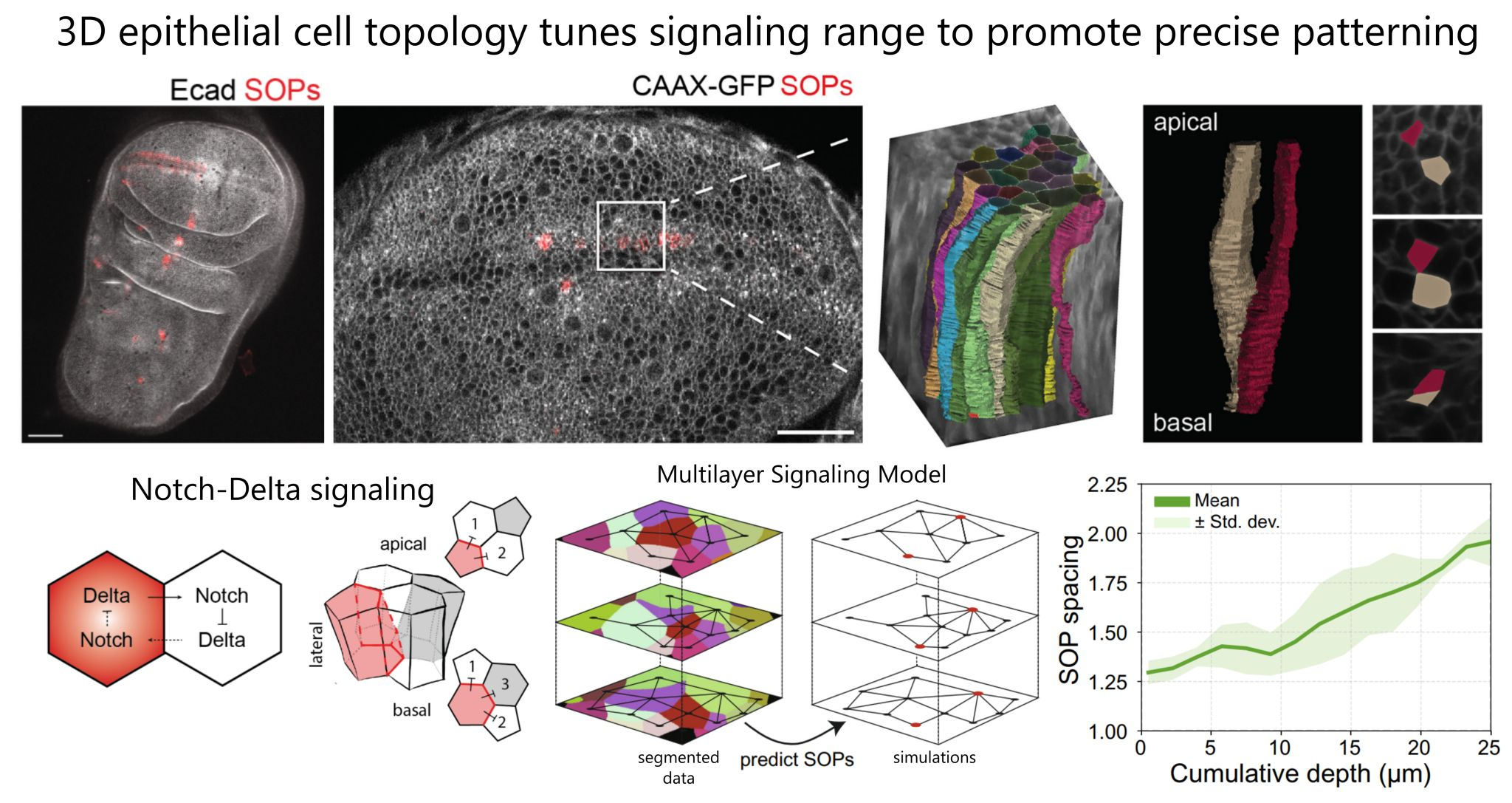
I am very pleased to share that our paper, “3D epithelial cell topology tunes signaling range to promote precise patterning”, has now been published in PNAS.
In this work, we ask how the three-dimensional geometry and topology of epithelial cells shape communication during development. Using the Drosophila wing margin as a model system, we show that scutoid-like cell geometries reorganise cell-cell contacts along the apico-basal axis, extending the effective range of Notch-Delta signalling and helping to promote precise sensory organ precursor patterning.
A central part of the study was the development of the Multilayer Signalling Model, which allowed us to simulate signalling on data-derived 3D epithelial geometries. Together with live imaging, 3D cell reconstruction, mathematical modelling, and in vivo perturbations, this gave us a way to connect epithelial shape directly to signalling range and patterning outcomes.
This project began during my PhD and grew into a rewarding collaboration at the interface of experiment and computation. I am especially grateful to my co-first author Giulia Paci, whose outstanding experimental work underpinned the study, and to Buzz Baum, Karen M. Page, and Yanlan Mao for their insight, guidance, and discussions over the years.
Resources
- Read the paper: doi.org/10.1073/pnas.2522727123
- Try the model: github.com/fberkemeier/MultiLayer-NotchDelta
- Documentation: multilayer-notchdelta.readthedocs.io